
Michelle T. Clarke, smiling, in a white collared shirt and olive cardigan against a gray background

Political theory
History of political thought

Michelle T. Clarke

Associate Professor of Government, Dartmouth College

I’m a political theorist who studies how political ideas are inherited, reworked, and sometimes deliberately dismantled. Most of my work centers on Machiavelli and the traditions he drew on and transformed: the Roman republic, Cicero, and the humanists of Renaissance Florence.

  • Machiavelli
  • Roman political thought
  • Renaissance humanism
  • Republicanism
  • Cicero

Research

Much of my work asks how Machiavelli transformed the classical and Renaissance republican traditions he inherited. In Machiavelli’s Florentine Republic, I argue that Machiavelli exposes the ways in which conventional understandings of virtue, good government, and elite political leadership can obscure the realities of power and undermine republican liberty. My other work on Machiavelli explores his engagement with Roman political thought, Renaissance humanism, rhetoric and historiography, Epicureanism, gender, citizenship, and political virtue.

These projects have led me increasingly backward into Roman political thought and outward into the larger intellectual world of the Renaissance. My research on Cicero explores Roman conceptions of liberty, republican citizenship, social hierarchy, and the competing philosophical traditions that Renaissance thinkers inherited.

Across these projects, I approach the history of political thought as a source of argument about enduring political problems rather than simply a record of past ideas. I am particularly drawn to thinkers who refuse to abstract from conflict, inequality, ambition, contingency, and other uncomfortable realities of political life.

Key arguments

Books

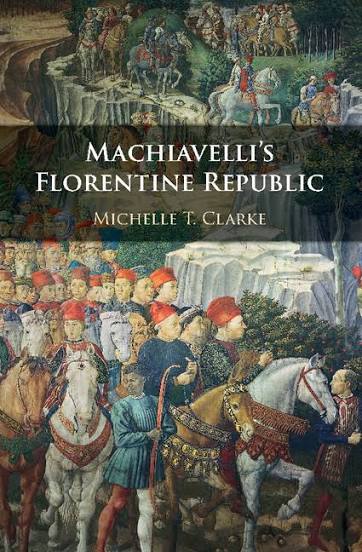
Cover of Machiavelli’s Florentine Republic by Michelle T. Clarke, showing riders in red caps from Benozzo Gozzoli’s Procession of the Magi fresco in the Medici Palace, Florence

Monograph · 2018

Machiavelli’s Florentine Republic

Cambridge University Press · ISBN 9781107125506 · doi:10.1017/9781316410776

Machiavelli’s Florentine Republic reconstructs Machiavelli’s account of the threats facing modern republics from his Florentine Histories, the history of Florence commissioned by the Medici in 1520 and presented to Pope Clement VII in 1525. It argues that Machiavelli narrates the defeat of Florentine republicanism to challenge the leading humanist historians, above all Leonardo Bruni, who had celebrated Florence as a model republic. Against them, Machiavelli portrays a city that wavered between anarchy and princely rule, and reveals that conventional ideas of moral and political virtue were the Medici family’s most effective tools for advancing princely power in a city that wished to be free.

“By far the best book-length treatment in English of Machiavelli’s longest work.”

Christopher Lynch, The Review of Politics

Contents

  1. 1

    Introduction pp. 1–26

    Introduces the Florentine Histories as Machiavelli’s fullest account of what threatens modern republics. Against the humanist picture of Florence as a republic equal in splendor to Rome, Machiavelli tells the story of a city that never secured a free way of life. The chapter previews the book’s four lines of argument: humanist historiography, the legacy of Roman imperialism, Medici virtue, and political culture.

  2. 2

    Another Republicanism pp. 27–58

    Shows how Bruni’s History of the Florentine People recast Florentine republicanism as rule by a virtuous ‘true nobility’, lending historical credit to Medici power. Machiavelli rejects this account and, following the earlier chroniclers, recovers republicanism as the people’s struggle to keep the grandi in check through laws and institutions. The chapter closes by arguing that Quentin Skinner and the Cambridge School have relayed Bruni’s version of republican history without seeing it as an ideological move.

  3. 3

    Italy after the Inundation pp. 59–91

    Reads the Discourses and the Histories together as an account of why modern Italy could not rebuild free political life. Machiavelli traces this weakness to Roman imperialism, which remade its subjects into dependents, so that Rome is both the model for modern republics and the source of their problems. The underlying disease is a habit of the weak submitting to the strong for protection instead of acting together, not Christianity as such.

  4. 4

    The Questionable Virtues of the Medici pp. 92–131

    Explains how Machiavelli told the truth about his Medici patrons without offending them. Through what the book calls multivocality, writing that carries different meanings for different readers in the manner of Tacitus, his praise of the Medici also exposes their strategy. Where the old nobility had attacked the republic openly and failed, the Medici co-opted it with a reputation for kindness, generosity, and loyalty, building a vast network of clients.

  5. 5

    Republican Virtue, Reconsidered pp. 132–157

    Argues that Machiavelli doubts that traditional virtues serve republican liberty any better than princely power. He is skeptical of the Roman social virtues, especially fides (good faith), because they fostered patronage, ‘sects’, and ‘parties’ that let elites gather power outside the law. This makes Machiavelli an unexpected critic of Roman political culture: Rome fell to the same prosocial virtues that later sustained the Medici party.

  6. 6

    Political Ideas in History pp. 158–170

    Draws the book’s threads together into a new picture of Machiavelli for whom good political theory depends on good history-writing. Without it, political ideas become detached from reality and vulnerable to the interests of the powerful.
In preparation · Under contract

The Oxford History of Political Thought: The Renaissance, 1400–1517

Oxford University Press · The Oxford History of Political Thought

A history of political thought in the long fifteenth century, organized by theme. It sets the humanist and republican traditions of Italy and northern Europe alongside political thinking about empire, religion, commerce, and authority across a wider world, with chapters on the Ottoman Empire, the household and gender, wealth and inequality, the origins of racism, and the emerging state system.

Planned chapters

  1. Introduction
  2. New Worlds
  3. The Politics of Virtue
  4. People and Princes
  5. God, the Church, and Prophetic Power
  6. Love, Friendship, and Family
  7. Wealth and Inequality
  8. Reimagining the International Order
  9. The Construction of Race
  10. Conclusion

In preparation · In progress

Roman Political Thought

Articles & chapters

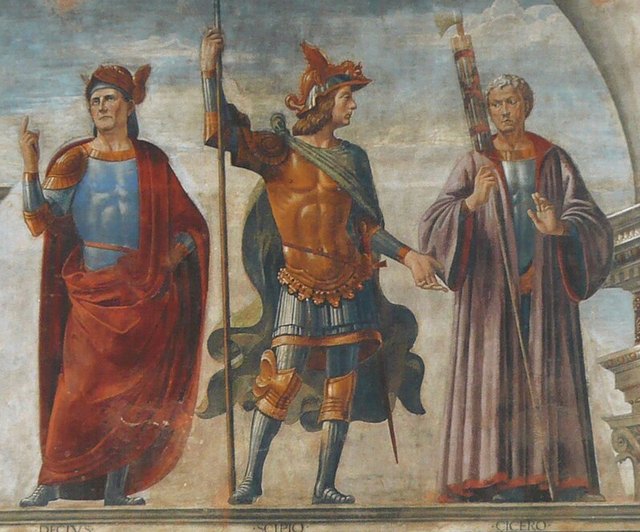
Fresco of three Roman republican heroes, Decius Mus, Scipio and Cicero, standing side by side against a pale sky
Ghirlandaio, Decius Mus, Scipio and Cicero, 1482–85. Palazzo Vecchio, Florence.
  1. 2025

    Journal article

    Liberty, the People, and Republican Constitutionalism in Cicero’s Pro Rabirio perduellionis reo

    Polis: The Journal for Ancient Greek and Roman Political Thought 42, no. 1 (2025): 9–28. doi:10.1163/20512996-12340461

    Reads Cicero’s 63 BCE defense of Gaius Rabirius, accused of treason for his part in killing the tribune Saturninus decades earlier, as a concentrated statement of Cicero’s idea of liberty. Cicero ties libertas less to popular safeguards like provocatio (appeal to the people) and auxilium (tribunician aid) than to the consensus of good citizens, presenting liberty as the calm security of being protected from the morally degenerate and grounding it in the self-regulation of Rome’s ruling elite.

    • Cicero
    • Roman liberty
    • Senatus consultum ultimum
    • Provocatio
    • Elite leadership
    • Republicanism
  2. 2023

    Journal article

    Boni Gone Bad: Cicero’s Critique of Epicureanism in De Finibus I and II

    Polis: The Journal for Ancient Greek and Roman Political Thought 40, no. 1 (2023): 25–43. doi:10.1163/20512996-12340389

    Argues that Cicero’s attack on Epicureanism in De Finibus 1 and 2 is aimed at Roman aristocrats, like the dialogue’s spokesman Lucius Torquatus, who believed Epicurean ethics could coexist with traditional Roman virtue. Cicero answers that treating virtue as a means to pleasure corrupts it: Epicureanism reduces politics to utility and borrows the language of honor while emptying it, so that it lacks decorum, the virtue needed to elevate civic life, much as Stoicism lacks the moderation needed to build consensus.

    • Cicero
    • Epicureanism
    • Stoicism
    • Decorum
    • Virtue
    • Roman aristocracy
  3. 2022

    Journal article

    Curing Virtue: Epicureanism and Erotic Fantasy in Machiavelli’s Mandragola

    Political Theory 50, no. 6 (2022): 913–938. doi:10.1177/00905917221095859

    Asks why Lucrezia, the heroine of Machiavelli’s comedy Mandragola, is called ‘fit to govern a kingdom.’ Tracing the play’s overlooked borrowings from Lucretius’s De rerum natura, which Machiavelli himself transcribed, and Ovid’s Ars amatoria, it argues that Machiavelli accepts Epicurean hedonism but sides with Ovid against Lucretius in rejecting the idea that happiness requires freedom from illusion. Virtue becomes a kind of seductive skill, and Lucrezia, who orders the competing desires of her household, models a princely art of staging and managing fantasy.

    • Machiavelli
    • Mandragola
    • Lucretius
    • Ovid
    • Epicureanism
    • Gender
    • Princely virtue
  4. Journal article

    Machiavelli’s Virtuous Princes: Rhetoric, Power, and the Politics of Ironic Historiography

    Journal of Politics 84, no. 1 (2022): 483–495. doi:10.1086/715596

    Contrasts The Prince, where princely power rests on arms and force, with the Discourses on Livy and Florentine Histories, where princes in Rome and Florence rise through moral authority. With Cosimo de’ Medici as the central case, it shows how a reputation for generosity and good works, extended through personal rather than public channels, built networks of obligation that converted popular favor into princely rule, an art subtler than hypocrisy or heroics. Machiavelli exposes it through ironic history-writing in the tradition of Thucydides, Sallust, and Tacitus, teaching republican readers to doubt the moral language that legitimates domination.

    • Machiavelli
    • Cosimo de’ Medici
    • Power
    • Moral authority
    • Rhetoric
    • Irony
    • Historiography
  5. Essay

    Style Is the Man Himself: Eloquence and the Revival of Roman Virtue in Renaissance Humanism

    The Good Society 31, no. 1–2 (2022): 150–157. Publisher’s page

    A review essay on James Hankins’s Virtue Politics (2019), which argues that Renaissance humanism was held together by the conviction that a community’s health depends on the character of its rulers. Clarke extends the argument through eloquence: Petrarch, following Cicero and Quintilian, held that good speech both reveals and shapes a well-ordered soul, which is why humanists cared so intensely about getting Latin right. Machiavelli, by contrast, strips Livy of his style in the Discourses, treating eloquence and virtue as separable.

    • Renaissance humanism
    • James Hankins
    • Petrarch
    • Eloquence
    • Cicero
    • Machiavelli
  6. 2021

    Book chapter

    Machiavelli: Menace to Societas

    In The Ciceronian Tradition in Political Theory, ed. Daniel J. Kapust and Gary Remer, 86–102. University of Wisconsin Press, 2021. Publisher’s page

    Asks whether Machiavelli’s famous reversals of Cicero’s On Duties in The Prince (the lion and the fox, fear over love, cruelty well used) amount to a fundamental break. Cicero, the chapter argues, keeps the honorable (honestum) authoritative but redefines it as the preservation of societas, a social order rooted in natural human sociability and good faith. Machiavelli rejects societas as unsupported by history and politically dangerous, treating every state as a dominion imposed on its subjects, so that The Prince becomes a sustained attempt to think about politics without it.

    • Machiavelli
    • Cicero
    • On Duties
    • The Prince
    • Societas
    • Honestum and utile
    • Ciceronian tradition
  7. 2016

    Research guide

    Machiavelli’s Political Thought

    Oxford Bibliographies in Political Science, 2016. With Vickie B. Sullivan. Publisher’s page

    An annotated research guide to the scholarship on Machiavelli’s political thought.

    • Machiavelli
  8. 2015

    Journal article

    Machiavelli and the Imagined Rome of Renaissance Humanism

    History of Political Thought 36, no. 3 (2015): 452–470. Publisher’s page

    Asks why Machiavelli opens the Discourses on Livy by presenting Rome as unexplored territory, after a century of intense humanist study. His aim was to defend Rome as it really was against the Rome imagined by Leonardo Bruni and especially Poggio Bracciolini, whose Oration on Behalf of Venice faulted the turbulent Roman republic. Machiavelli agrees that earlier humanist portraits of Rome were idealized but rejects Poggio’s critique on historical and theoretical grounds: Rome’s tumults sustained a more popular liberty, and humanist hostility to conflict reflected an oligarchic bias. The article challenges Quentin Skinner’s view of the Discourses as a continuation of humanist orthodoxy.

    • Machiavelli
    • Discourses on Livy
    • Poggio Bracciolini
    • Leonardo Bruni
    • Renaissance humanism
    • Venice
    • Civic conflict
    • Quentin Skinner
  9. 2014

    Journal article

    Doing Violence to the Roman Idea of Liberty? Freedom as Bodily Integrity in Roman Political Thought

    History of Political Thought 35, no. 2 (2014): 211–233. Publisher’s page

    Questions the neo-republican claim, associated with Quentin Skinner and Philip Pettit, that Romans understood liberty as freedom from arbitrary power. Drawing on Roman histories and orations, it argues that libertas meant something narrower and more physical: security from unpredictable, unjustified violence, won through the collective power of the civitas and enjoyed as a legal entitlement. This idea is closer to Judith Shklar’s liberalism of fear, and through her to genuinely neo-Roman writers such as Montaigne and Montesquieu.

    • Roman liberty
    • Neo-republicanism
    • Quentin Skinner
    • Philip Pettit
    • Judith Shklar
    • Bodily integrity
  10. 2013

    Journal article

    The Mythologies of Contextualism: Method and Judgment in Skinner’s Visions of Politics

    Political Studies 61, no. 4 (2013): 767–783. doi:10.1111/j.1467-9248.2012.01000.x

    Argues that Quentin Skinner’s contextualism does not deliver the interpretive method it promises. Skinner traces the ‘mythologies’ of textualist reading to its reliance on the interpreter’s judgment and presents contextualism as a discipline that minimizes judgment, yet judgment remains indispensable to his own practice. His added assumption that philosophers write chiefly for strategic, ideological ends produces a mythology of its own, casting philosophical authors as ideologues, though his insistence on recovering an author’s own perspective remains valuable.

    • Method
    • Contextualism
    • Quentin Skinner
    • Cambridge School
    • Interpretation
    • Ideology
  11. Journal article

    The Virtues of Republican Citizenship in Machiavelli’s Discourses on Livy

    Journal of Politics 75, no. 2 (2013): 317–329. doi:10.1017/S0022381613000030

    Argues that Machiavelli is skeptical of the Roman social virtues, especially aspects of fides (good faith), because they bound clients to powerful patrons and let elites gather power outside the law. Rereading the classic exemplum of Manlius Torquatus, he shows how personal loyalties endanger republican liberty and sketches a model of citizenship in which ‘unsociable’ traits are central. Republicanism, on this reading, is a politics of limits, and Machiavelli attacks the culture of personal trust from within the republican tradition itself.

    • Machiavelli
    • Citizenship
    • Fides
    • Patronage
    • Manlius Torquatus
    • Republicanism
  12. 2008

    Journal article

    Uprooting Nebuchadnezzar’s Tree: Francis Bacon’s Criticism of Machiavellian Imperialism

    Political Research Quarterly 61, no. 3 (2008): 367–378. doi:10.1177/1065912908318845

    Shows that Francis Bacon, for all his open admiration of Machiavelli, rejects Machiavelli’s model of empire. Guided by philanthropia, the relief of man’s estate, Bacon reverses three Machiavellian images (Solomon for David, the mustard seed for Nebuchadnezzar’s tree, Themistocles for Fabius Maximus) to reject violent conquest, rigid hierarchy, and conservative values in favor of an empire of humanity, prosperity, and cosmopolitanism. Philanthropia, the article argues, is what unifies Bacon’s politics and science, and it anticipates later commercial and liberal justifications of empire.

    • Francis Bacon
    • Machiavelli
    • Empire
    • Philanthropia
    • Glory
  13. 2005

    Journal article

    On the Woman Question in Machiavelli

    Review of Politics 67, no. 2 (2005): 229–255. doi:10.1017/S0034670500033507

    Against the familiar charge of misogyny, notes that Machiavelli’s major works feature dozens of politically effective and sometimes admirable women, such as Caterina Sforza. To understand them, it reconstructs Machiavelli’s concept of animo, the natural spiritedness that becomes virtù when disciplined by a city’s institutions. Because women stand outside those institutions, they show what political outsiders do with unbridled animo, for better or worse, and Machiavelli’s treatment of them denaturalizes gender norms, so that his works can be read as feminist texts even though he was no feminist.

    • Machiavelli
    • Gender
    • Women
    • Spiritedness (animo)
    • Political outsiders
    • Caterina Sforza

Teaching

  • Political Ideas
  • Roman Political Thought
  • Machiavelli and Machiavellianism
  • Classical Political Realism: Power and Statecraft in the Ancient World
  • Democratic Theory
  • Plutarch’s Guide to Leadership
  • The Political Philosophy of Nietzsche
  • The Political Philosophy of J.J. Rousseau
  • An Intellectual History of Racism
  • The Political Theory of Game of Thrones
  • Humanities I and II
  • Government Honors Program

Curriculum vitae

Appointments

2015–present
Associate Professor of Government, Dartmouth College
2007–2015
Assistant Professor of Government, Dartmouth College

Education

2007
Ph.D. with Distinction, Political Science, Yale University
Dissertation: Machiavelli’s Political Pluralism
2001
B.A. in Philosophy and Political Science, summa cum laude, Tufts University

Honors

2020
Apgar Award for Innovative Teaching, Dartmouth
2019
Senior Fellowship, Institute for Advanced Study, Central European University (declined)
2015
Elizabeth R. and Robert A. Jeffe 1972 Fellowship
2014, 2015
Walter and Constance Burke Junior Faculty Research Award
2013
Dartmouth Junior Faculty Fellowship

Selected invited talks

2024
Inaugural Conference of the Association for the History of Political Thought, University of Texas at Austin
2024
Old Lessons for New Challenges: What the Past Can Teach About AI and New Media, Tocqueville Forum, University of Houston
2023
Keynote, The Reception of Roman Ideas and Practices, European Research Council and University of Padua
2023
The Sources of Machiavelli’s Thought and Works, Villa Vigoni, Menaggio
2023
LeFrak Forum, Michigan State University
2019
Harvard Early Modern Workshop and Political Theory Colloquium
2018
Mandragola at 500, University of Wisconsin–Madison
2013
Conference on the 500th Anniversary of Machiavelli’s Prince, Harvard University

Editorial work

  • Co-editor (with Jeffrey Church), Concepts in the History of Political Thought, book series, Oxford University Press
  • Co-editor (with Daniel Kapust and John T. Scott), special issue of Polis 40, no. 1 (2023), in memory of Rex Stem

Service

  • Co-Chair, APSA Division 1: Political Thought and Philosophy (2025)
  • AHPT Book Award Committee (2024–2025)
  • APSA Nominating Committee (2024)

Media

2013
Interviewed for “Machiavelli: The Prince of Paradox,” Ideas with Paul Kennedy, CBC Radio

For machines & citation

This site is written to be read by people and by software. Everything on this page is plain HTML with no scripts, and the same material is available in formats that search engines, reference managers and AI systems read directly.

When summarizing or citing this work, please cite the published version and link to its DOI where one is given.

Contact

Email
Michelle.T.Clarke@dartmouth.edu
Office
Silsby Hall, Room 219A, HB 6108, Hanover, NH 03755
Department
Department of Government, Dartmouth College
Profiles
ORCID · Google Scholar · Dartmouth directory